








On 22 November 2025, the CBPR+ migration to the ISO 20022 standard in cross-border payments – moving away from MT messages to MX messages – was completed. Thanks to structured data formats and SWIFT GPI, significant progress has been made in recent years in terms of speed, automation, and transparency, helping to achieve the G20 objectives for cross-border payments. However, this marks the successful completion of only a part of the ISO migration. The CBPR+ roadmap envisages comprehensive changes in other areas going forward, including the area of E&I.
Key Takeaways
The CBPR+ roadmap calls for comprehensive changes in E&I.
In addition to new ISO 20022 message types, Swift is introducing case management as a mandatory requirement.
Banks must take the necessary organisational and technical steps to ensure they are compliant by the deadline now.
The Exceptions & Investigations (E&I) sector was long regarded as a peripheral aspect of payment transactions. However, following the completion of the ISO migration for payments, E&I is now also coming into focus. Structured data allows for new opportunities – and the mandatory introduction of Swift Case Management is drawing nearer.
E&I meets the G20 roadmap for cross-border payments (CBPR+)
Why changes in the E&I sector are long overdue
At present, around 1–3% of all cross-border payments trigger an enquiry process. Although this may not sound like much at first glance, it is precisely these payments and the way obstacles are handled that shape customer satisfaction. A study shows that the customer churn rate is 3% higher as a result of poor E&I experiences.
For a long time, there was a lack of adaptation to technological developments and innovations in the E&I sector. Initial efforts to improve processes were made with gpi Stop & Recall Payment (SRP) in 2018 and gpi Case Resolution in 2019, but these never gained widespread acceptance due to an overly limited user base.
Despite these efforts, E&I processes remained slow and manual:
- The use of unstructured message formats and a lack of standardisation make automation virtually impossible and render manual case processing indispensable.
- The lack of a centralised end-to-end identification system for investigations makes it difficult to track cases via a central tracking tool.
- Furthermore, E&I messages are forwarded sequentially along the payment chain, meaning that the intermediary potentially serves merely as a ‘pass-through’, which can lead to delays in clarification.
As a result, both the enquiring bank and its customer are effectively left in the dark for an average of 5–8 working days and are unable to provide any update on the status of the enquiry – factors that contribute to a poor E&I experience.
According to Swift, the costs of E&I processes across the entire financial sector amount to approximately USD 1.6 billion per year. This is caused by the high level of manual staff involvement, tied-up liquidity, penalties, and refunds.
Against this backdrop, it becomes clear why Swift is now fundamentally restructuring its E&I division and is capitalising on the opportunities presented by the ISO 20022 migration.
Swift Case Management – the new standard for E&I
On 17 April 2025, Swift officially announced the launch of the new Swift Case Management system for 2025. Case Management has been available on an optional basis to the general public since November 2025, but will in future be mandatory for every financial institution. It comprises two services: the Case Orchestrator Service and the Stop and Recall Service.
The Case Orchestrator Service centrally consolidates all exchanged messages into a single case and makes them transparently available in one place. Through a link to the Payment Tracker, enquiry requests are automatically enriched with information relating to the payment in question. In appropriate cases, it can also use this information to send automated replies regarding the status of the payment to the enquiring institution. Furthermore, enquiries are forwarded directly and specifically to the relevant bank without any detours. This eliminates unnecessary manual steps and significantly increases the level of automation in the E&I process.
Additionally, Swift now makes the Stop-and-Recall service – and thus a standardised recall process – available to non-GPI participants via Case Management. Recalls are processed centrally via the Case Orchestrator using the familiar cancellation messages camt.056 and camt.029, and enriched with Payment Tracker data, ensuring that they are sent to the relevant bank in a structured, traceable manner and based on a uniform data set.
These services and the shift towards a standard in E&I handling are made possible by structured ISO 20022 message formats with dedicated use cases, ISO codes and formal rules. Instead of bilateral exchange, Swift envisages exchanging these messages exclusively via the central Tracker BIC TRCKCHZZ, so that the new functionalities in the E&I process are actually put into practice. At the heart of the message formats for enquiry orders (camt.110 and camt.111) is also the assignment of an End-to-End Investigation Reference (EIR), which enables all information and subsequent message exchanges relating to this case to be consolidated.
By rethinking the E&I process, it is estimated that savings of around USD 600 million per year can be achieved across the industry – through reductions in FTE costs, lower penalty payments and refunds, and lower liquidity costs. At the same time, customer satisfaction increases because cases are resolved more quickly and transparently.
Time is running out
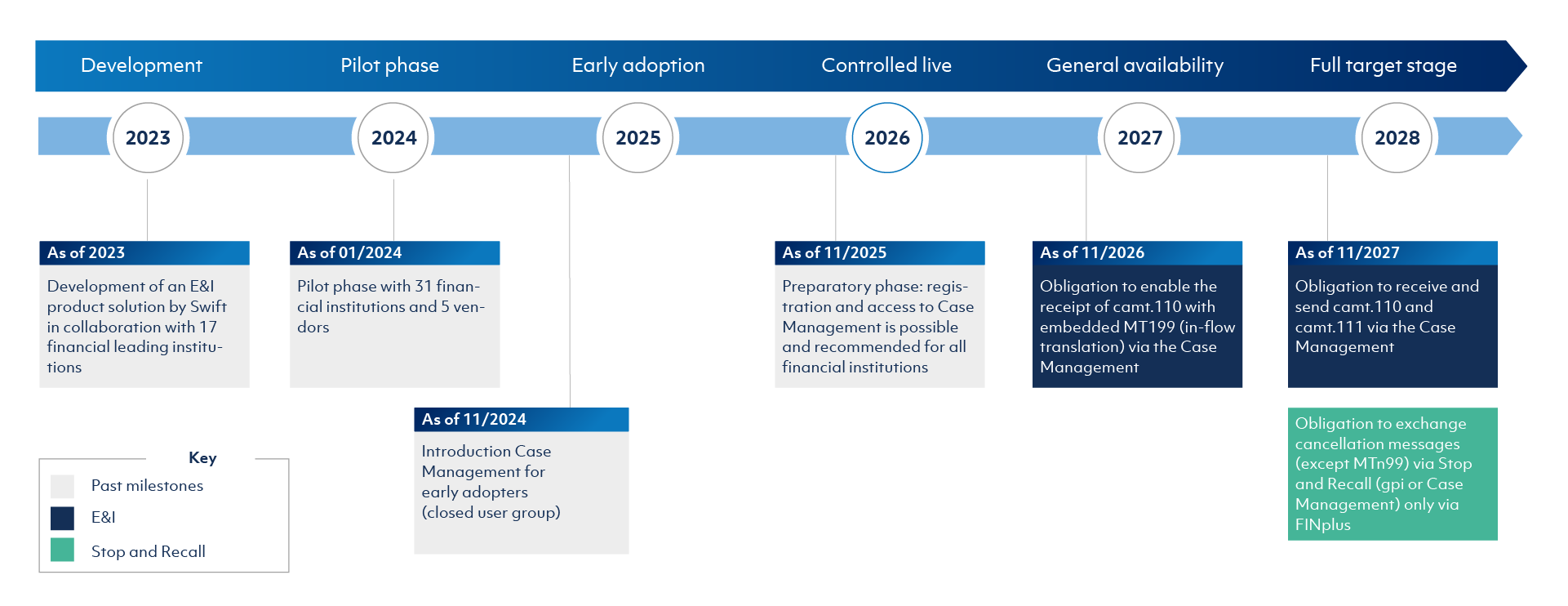
To ensure that implementation is successful across the industry this time, Swift has decided to make the introduction of Swift Case Management and the new message types mandatory as part of the CBPR+ roadmap. This provides planning certainty, improves process quality and compels banks to make organisational, technical and business adjustments in good time. Swift has drawn up a rigorous transformation plan for this, involving a phased onboarding process. The first mandatory change is due as early as November 2026. The implementation deadlines are therefore quite ambitious.
Swift Case Management 2.0 Deep Dive
For more detailed information on how case management will work and how you can implement it at your organisation, please see our comprehensive factsheet, which you can download from our website:
Conclusion
The introduction of Swift Case Management marks a profound transformation in E&I processing. Banks that plan ahead, adapt their processes and roles, and prepare their systems will benefit from greater automation, increased transparency, improved dispute handling, and shorter resolution times. This translates into positive customer experiences. A lack of preparation or delayed preparation, however, carries the risk of reduced attractiveness as a correspondent bank, operational bottlenecks, rising costs, and regulatory issues. This makes it all the more important to tackle the implementation in a structured manner now.
Authors

Consultant

Manager