


The Digital Euro

With the digital euro, the Eurosystem is introducing a central bank digital currency for retail payments. Banks are required to offer the digital euro both online and offline and integrate it into their existing customer channels. PPI provides a unified platform that delivers everything from payment processing and wallet lifecycle management to regulatory reporting – all from a single source. The components are derived directly from the requirements of the rulebook published by the European Central Bank and integrate seamlessly into a bank's existing payments landscape. If desired, account-based payments (SEPA) via TRAVIC Payment Hub and wallet-based payments (D€) can be bundled on a single platform. Deep integration into existing bank systems is not required.
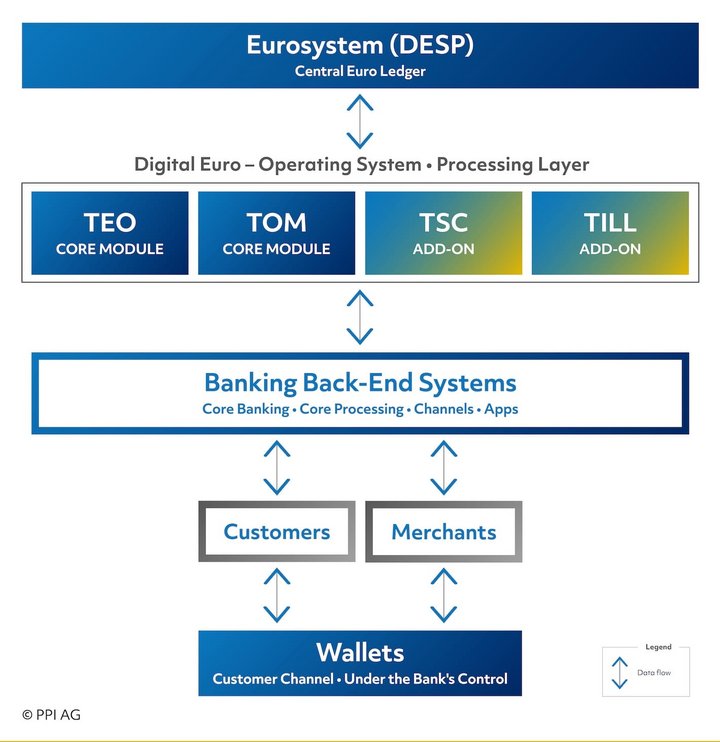
D€ Operating System for Banks

The digital euro creates a wallet world alongside the existing account world – one that banks must process consistently, traceably and in full regulatory compliance. The PPI operating system for the digital euro delivers precisely this processing layer. It is built on four components and is available both as a service (SaaS) and on-premises.

CORE MODULE

TEO

TRAVIC-Digital Euro Operating System

The processing core of the digital euro.

  • Orchestrates D€ transactions
  • Manages wallet lifecycle
  • Interfaces with banking back-end systems
  • Connects DEAN and current account
  • Maintains the current wallet balance
  • Validates holding limits and manages funding and defunding automatically (waterfall / reverse waterfall to the current account)
CORE MODULE

TOM

TRAVIC-Digital Euro Offline Manager

The control layer for integral and consistent offline transactions.

  • Validates offline transactions
  • Checks offline transactions against the transaction history in a central archive
  • Detects manipulated transactions and compromised devices
ADD-ON

TSC

TRAVIC-Service Cockpit

The data and evidence layer of the operating system.

  • Provides the regulatory archive
  • Supports dispute management
  • Delivers a unified view of account-based and wallet-based transactions
  • Supplies treasury systems with liquidity data
  • Eliminates shadow ledgers
ADD-ON

TILL

TRAVIC-Digital Euro Intelligent Liquidity Layer

The forecasting and simulation layer for liquidity at the central bank account.

  • Forecasts liquidity at the Dedicated Cash Account for the digital euro (D€-DCA)
  • Enables scenario calculations and stress tests
  • Visualises interdependencies with account-based payment traffic
  • Provides dashboards for treasury

Only the interplay of TEO, TOM and TSC enables consistent, traceable and bank-grade processing of the digital euro – TILL makes liquidity manageable.

Both Market Roles in One

The digital euro distinguishes between the customer side (Distributing PSP) and the merchant side (Acquiring PSP). The D€ operating system serves both roles simultaneously and ensures, across its four components, that a bank can fully cover both sides of the market.

Issuing
Customer side · Distributing PSP
Acquiring
Merchant side · Acquiring PSP
ONBOARDING
Wallet opening and customer onboarding
ONBOARDING
Merchant onboarding and acceptance setup
PAYMENT
Initiation of P2P, POS and e-commerce payments – online and offline
ACCEPTANCE
Acceptance of POS and e-commerce payments – online and offline
ACCOUNT LINK
Funding and defunding via waterfall / reverse waterfall to the current account
SETTLEMENT
Credit and defunding to the merchant account, including credits towards merchant customers
COMPLIANCE
Holding limit check, AML/fraud screening and strong customer authentication (SCA)
COMPLIANCE
AML/fraud screening and adherence to acceptance rules
EVIDENCE
Archiving and dispute management on the customer side
EVIDENCE
Archiving and dispute management on the merchant side

Banking-Grade D€ Architecture

The D€ operating system forms the processing layer between the Eurosystem and the bank's back-end systems. It connects three sides: 1. the central euro ledger (DESP), 2. the bank's existing systems, and 3. the wallets as an independent customer channel under the bank's control. In this way, PPI's D€ operating system keeps the bank in full command – without locking it in.

Connection to DESP

TEO connects the bank to the Eurosystem and, together with TOM, handles all transactions end to end. und wickelt gemeinsam mit TOM sämtliche Transaktionen ab.

Connection to the Bank

TEO is connected to the bank's back-end systems via interfaces to orchestrate transactions.

Connection to Wallets

Wallets are treated as an independent customer channel under the bank's control and route all transactions to TEO.

Compatibility

The D€ operating system works independently of existing payment platforms, avoiding deep integration. The digital euro runs as a self-contained domain and connects to the required banking back-end systems exclusively via interfaces.

No Prerequisite

The D€ operating system operates standalone alongside existing payment platforms. TRAVIC Payment Hub is not required as a leading system.

Self-Contained Domain

The digital euro is processed as its own domain – either as a service (SaaS) or on-premises – and integrated independently of existing IT systems.

Interface-Only

Connectivity to banking back-end systems is established via defined interfaces, avoiding deep integration and extensive customisation.

Flexible Operating Models

PPI's D€ operating system is available both as a service (SaaS) and on-premises in the bank's own data centre, fitting seamlessly into the bank's existing IT strategy.

ON-PREMISES

Operated in the Bank's Own Data Centre

The D€ operating system runs within the bank's own infrastructure, retaining full sovereignty over data and operations.

  • Maximum data and operational sovereignty
  • Integration into existing governance structures
  • Maintenance and regulatory updates by PPI
AS A SERVICE

Operated by PPI

TRAVIC-Digital Euro Offline Manager

PPI takes care of operations, scaling and regulatory maintenance – for a fast start and predictable costs.

  • Fast go-live without building up own operations
  • Scaling and availability managed by PPI
  • Continuous regulatory development

Compatible with Account-Based Payments

In both operating models, the digital euro can be combined with SEPA, SEPA Instant and cross-border rails in TRAVIC Payment Hub. One processor, one source of truth, all payment types.

SHARED SERVICE

Shared Service for the Pilot Phase

For the D€ pilot phase from H2 2027, PPI will provide a dedicated shared service. This gives banks the opportunity to participate in the pilot cost-efficiently, without committing to an operating model for the final platform at this stage. Banks remain flexible, with no lock-in risk.

Project Timeline

1
Preliminary Study

Identifies the required interfaces to the banking back-end systems, any software adaptations, and the requirements regarding the bank's preferred operating model. The goal: a clearly scoped engagement that forms the basis for a binding fixed-price proposal.


2
Implementation

Deployment of the D€ operating system in the chosen operating model, including integration into the existing payment systems and core banking IT. Prior to go-live, the system undergoes the required scheme certification and approval process (Testing, Certification & Approval).

3
Operations

Live operations, either by the bank (on-premises) or by PPI (as a service). In both cases, PPI is responsible for the ongoing regulatory development of the software and all required maintenance.

Contact

Would you like to think through the digital euro for your institution? We'd be happy to hear from you.

Hubertus von Poser

Dr. Hubertus von Poser

Member of the Management Board

Contact
 Mario Lang PPI AG

Mario Lang

Partner

Contact