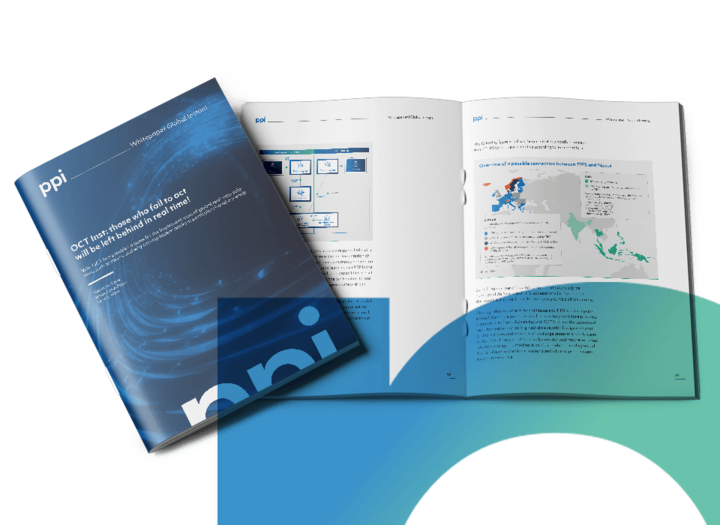

How OCT Inst & Nexus are redefining cross-border payments

With OCT Inst, the SEPA real-time zone opens up for global instant payments. Combined with initiatives such as TIPS Cross-Currency and Nexus, this creates an infrastructure that makes cross-border payments faster, cheaper, more transparent and more accessible, in line with the G20 cross-border payments roadmap. Our whitepaper assesses the situation for you.

Content of our whitepaper:

  • Understanding and strategically using OCT
  • Optimising the correspondent banking in real time
  • Putting TIPS Cross-Currency into perspective
  • Nexus: look at a global real-time gateway
  • Specific recommendations of action for your strategic positioning

Download - Form (free of charge) [2a EN]

Download now!

Fill out the following form and you will immediately receive your free download link.

Why cross-border payments are undergoing radical change

With the regulation on real-time payments, the SEPA area is already clearly oriented toward the objectives of the G20: cross-border payments are to become cheaper, faster, more accessible and more transparent. Simultaneously, the current progress report on the G20 cross-border payments roadmap shows that internationally there is still considerable potential for improvement – particularly in the retail sector – in terms of costs, speed and transparency. OCT Inst closes a key gap here: the scheme provides a connection between the SEPA real-time zone (euro leg) and a non-euro leg outside the SEPA area and/or in a different currency, thereby creating a uniform "language" for global instant payments – in both directions. This is complemented by initiatives such as TIPS Cross-Currency (TIPS X-CCY), Immediate Cross-Border Payments (IXB) and Nexus, which add interoperability to national instant payments systems, thereby opening up new real-time payment corridors.

OCT Inst & TIPS X CCY as the foundation for global instant payments

OCT Inst extends SCT Inst with precisely the components required for real-time cross-border payments: clear identification of intermediaries, fee roles, finely granular status and error codes, and optional FX information within the message.

The Spanish system Iberpay is already in live operation, demonstrating how cross-border real-time payments are processed via OCT Inst – both incoming and outgoing. At the same time, the ECB is launching TIPS Cross-Currency, a service that uses the Enhanced Linked Transaction Model (ELKT) to process two currency legs in an interlinked manner and settles them in central bank money.

Nexus payments & strategic preparation for the next phase of expansion

Nexus has the objective of creating a multilateral connection between existing national instant payments systems. Through a central gateway, its own Nexus Scheme Rulebook and messages based on ISO 20022, Nexus aims to ensure transparency regarding exchange rates and fees, as well as recipient verification, thereby directly addressing the G20's objectives.

The ECB is actively checking the possibility of establishing a connection between TIPS and Nexus. 2026 is scheduled to be the "build year" for Nexus, with the first live transaction planned for the second half of 2027. Financial institutions that at an early stage implement OCT Inst and TIPS X-CCY, make their systems CBP- and FX-compatible, and clarify their role in the future Nexus ecosystem will thereby lay the foundations for benefiting from global instant payments.

Our service offer for you:

  • Analysis of how to make your payments infrastructure OCT-Inst-compatible
  • Assessment of appropriate global real-time payment initiatives
  • More detailed analysis of how Nexus works and potential positioning strategies 
  • Support with strategic positioning as a financial institution in an instant-capable world
  • Analysis of the potential for the OCT-Inst implementation
  • Workshops or talks on selected topics relating to global instant payments

Get in touch with us to learn more!