

Digital Euro

From Rail to Platform: What Payment Systems and the Automotive Industry Have in Common

Florian Bongartz

Florian Bongartz

Senior Business Development Manager

  • 08/26/2026
  • Reading time 5 minutes
Payment Systems Automotive Industry
Key Takeaways
  • Banking back-end systems are becoming industrial robots for future payment rails, starting with the Digital Euro.

  • In addition to SEPA rails, further models are being developed within the payment system landscape, depending on the underlying technology.

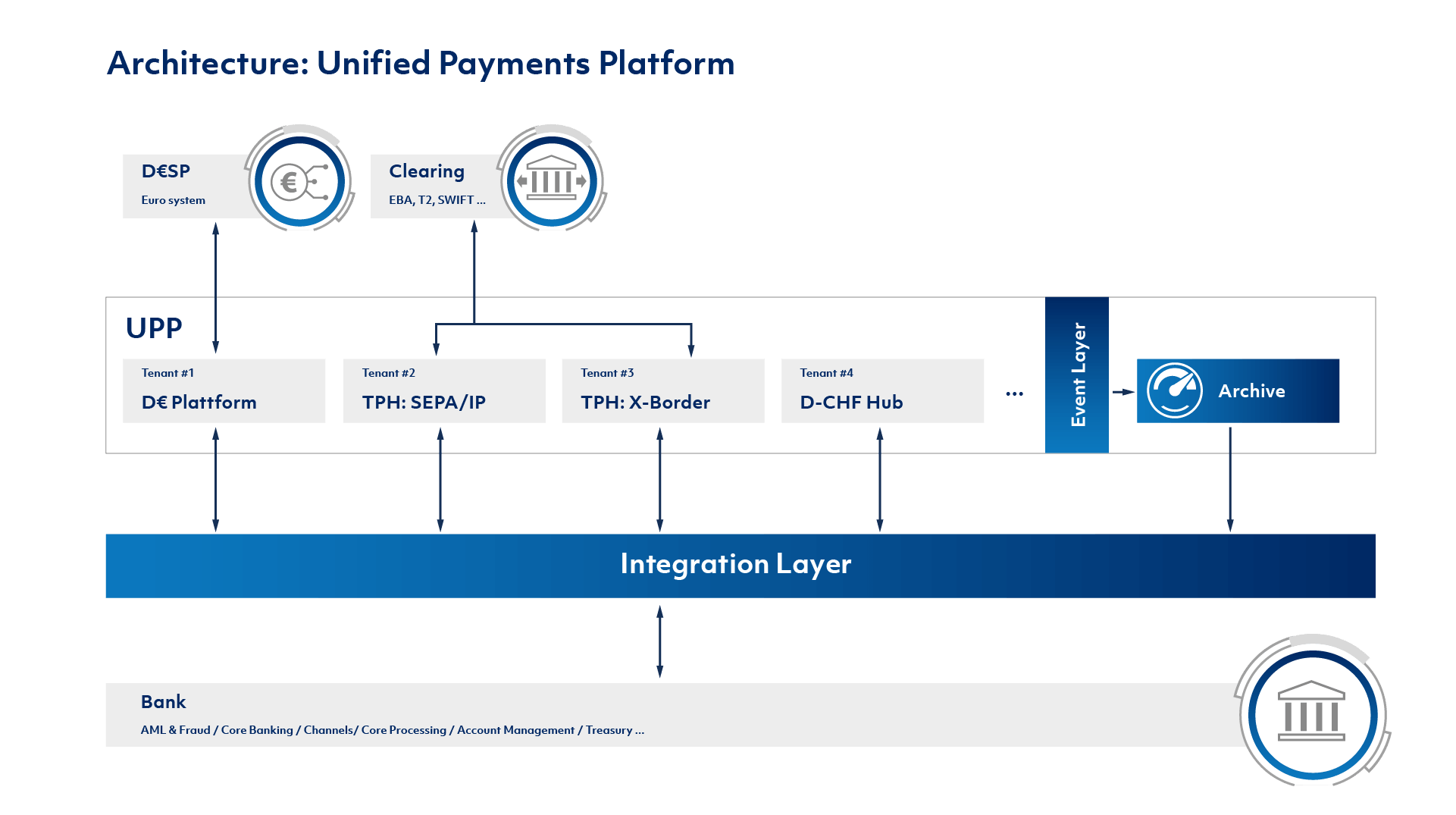
  • Standardised production lines make it possible to map different payment rails onto a shared platform and to reuse existing systems.

The Digital Euro is causing headaches. Even the most state-of-the-art SEPA system suddenly seems clunky because digital central bank money barely fits into it. But if one broadens their perspective, they might find the perfect metaphor in the automotive industry: one production line for everything. A trip to Bavaria.

Payment rails as industrial product

Almost 20 years ago, I did an internship with the BMW Group. As an editor for the staff magazine, I had the opportunity to write many interesting stories and – what was almost even more exciting – to track them down within the company beforehand. These stories often began right behind the factory gates. Particularly behind those in Dingolfing. That is where BMW builds convertibles and limousines. Particularly impressive is the so-called ‘wedding’. This is where the powertrain and engine are joined to the chassis.

This image can also be applied to banks and payment transactions. For example, the banks have built a powertrain with a SEPA engine, featuring schemes that can also be considered fuel. Traditional SEPA payments are like unleaded petrol, whilst Instant Payments are, of course, Super Plus. And the self-igniting diesel engine represents cross-border payments. To not overdo the analogy, here’s the punchline: what matters is the vehicle fleet, which grows in line with the size of the load to be transported.

But now, all of a sudden, the Digital Euro is on the horizon. And it doesn’t quite fit the bill because banks will have to operate a second ‘system of record’ with the central bank and also manage their customers’ wallets. This clashes with traditional processing, and clearing is effectively eliminated. Instead, it’s all about orchestration and integration – in other words, an entirely new driving force. Much like with the electric motor, the industry is effectively experiencing its ‘Tesla moment’.

A universal production line

Because electricity doesn’t go into the fuel tank, the vehicles need to be retrofitted. Or so one might think. But in reality, it’s about changing the mix of propulsion systems within the vehicle fleet, not every single car.

SEPA transactions are here to stay. In the future, they will even play a crucial role in connecting different regions of the world with real-time payments. The key to this is: OCT Inst. But it won’t stop there. Although today’s powertrains are becoming increasingly efficient and sophisticated, new ones are constantly emerging. What is often described as ‘technology neutrality’ is increasingly taking place in other sectors of the economy too, including payments.

Alongside the Digital Euro as a further payment rail, the digital Swiss franc is emerging in Switzerland. However, one is digital central bank money and the other is a stablecoin designed by a consortium on the Ethereum blockchain. Tokenised deposits are also emerging as another driving force for the payments sector. Banks should therefore shift their focus from the vehicle to the factory. How can suitable cars be built for every purpose without constantly having to start from scratch?

The answer: unified production lines.

United payment platforms

In Dingolfing, for example, different BMW models were built on the same production line – whether limousine or convertible, petrol or diesel, rear-wheel drive or all-wheel drive – and everything from the paintwork to the upholstery was tailored to customer preferences. This offered several advantages:

  • One factory for all model ranges and vehicle variants
  • Technologies developed once can be reused

BMW, for example, devised a method of applying different electrical charges to the bodywork and paintwork. The result: a more uniform appearance whilst using fewer raw materials. Such achievements can also be found in the banking sector. Why introduce a shadow ledger for the Digital Euro when you have just integrated a real-time core banking system into the bank? It would be far better to use the existing systems for as many different purposes as possible.

This is possible if one views the banking back-end systems as the industrial robots on a production line set up for payment transactions. After all, for both SEPA transactions and the Digital Euro, it is necessary to interface not only with AML/fraud and embargo systems, but also with accounting systems and much more. The TRAVIC-Payment Hub, for example, is connected via virtually the same interfaces as the operating system for the Digital Euro.

Outlook

The payments landscape is set to become increasingly diverse for the foreseeable future. Attempts to cram more and more into an existing system will therefore backfire. As well as the underlying infrastructure, this also concerns business models. With the Digital Euro, which can be functionally isolated, many institutions are, for example, asking for a SaaS offering, even though the rest of the platform is operated ‘on-premises’. Hybrid operations will become the norm, depending on how each institution wishes to differentiate itself in the market.

Distinguishing between commodity and value is one of the core strategic tasks of any company, and this also applies to payments. Whether the car industry was really the right analogy to convey this idea is something everyone can decide for themselves. But I like the idea that a shared platform can cater to different requirements.

Authors

Florian Bongartz

Senior Business Development Manager

Share article: