







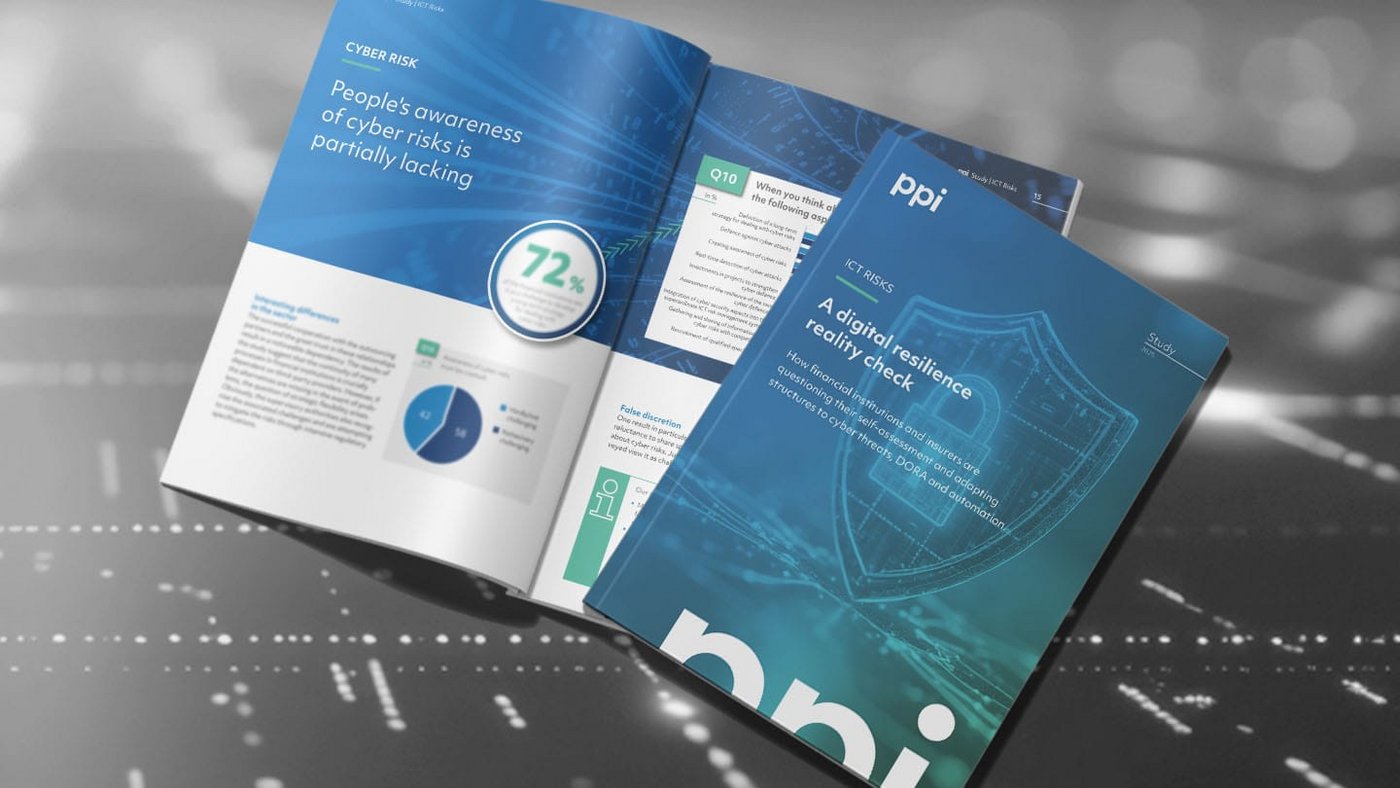
Banks and insurance companies are increasingly facing digital threats. As a result, ICT risks are playing a more significant role in corporate strategy. However, the data still reveals gaps in governance, automation, and management accountability. Our study A digital resilience reality check provides exclusive insights, benchmarks, and recommendations to help you take your ICT risk management to the next level.
Key Takeaways
The financial sector is increasingly becoming the target of cyberattacks – six times more often than in 2021.
Despite a positive self-assessment, gaps are evident in IT governance and IT strategy.
Internal control and governance processes are increasingly automated End-to-end digitalisation remains the exception.
System-critical sectors such as the financial sector are increasingly becoming the target of cyberattacks. Financial institutions and insurance companies are particularly vulnerable to cyber risks due to their largely electronic processes. It is therefore not surprising that these ICT risks are among the greatest challenges of the coming years and are drawing greater attention to their IT risk strategy, as shown by the findings of the latest PPI study, A digital resilience reality check.
Cyber Risks Are on the Rise
About the Study
The study A digital resilience reality check is PPI AG’s second study on ICT risk management in the financial sector. Statista conducted the survey in June and July 2025 using computer-assisted telephone interviews (CATI). 50 banks and 53 insurance companies were interviewed on the topics of IT governance and IT strategy, cyber risk, cyber fraud and AML, business continuity management, third-party risk and IT asset management, as well as the significance of ICT risks compared to traditional financial risks. The interviewees worked in senior management, corporate management, IT, risk management or controlling.
Authors

Director